
The Enslaved Were Never Passive
The dominant narrative of slavery as something that 'happened to' Africans erases centuries of active resistance. Resistance was continuous, multi-form, and documented.
Forms of resistance
- Marronage: escaping and forming free communities. Jamaica's Maroon War (1728–1739) forced the British to sign a treaty recognizing Maroon sovereignty. Brazil's Quilombo dos Palmares (1605–1694) was a free republic of an estimated 11,000–30,000 people at its peak (scholarly estimates vary) — the longest-surviving free Black community in the Americas.
- Shipboard rebellions: The Amistad (1839) is famous but was one of 485 documented shipboard revolts recorded in the SlaveVoyages database.
- The Haitian Revolution (1791–1804): The only successful slave revolution in history, producing the first Black republic. Napoleon sold the Louisiana Territory to the US in 1803 after the Haitian Revolution — combined with the yellow fever epidemic that killed General Leclerc and 50,000+ French troops — destroyed his Caribbean ambitions.
- Day-to-day resistance: feigned illness, work slowdowns, breaking tools, preserving culture, maintaining language, planting African seeds in hair.
Omar Ibn Said: Scholar, Enslaved, Never Broken
Omar Ibn Said (c. 1770–1864) was a Fula Islamic scholar from Senegal who was enslaved in 1807 and brought to North Carolina. He wrote at least 14 manuscripts in Arabic while enslaved — including his 1831 autobiography, now housed at the Library of Congress. He wrote Arabic inscriptions on the walls of his jail cell. His manuscripts include Quranic passages, biographical accounts, and a copy of the Lord's Prayer he was asked to write — which he surrounded with Quranic verses.
Omar Ibn Said's existence is a complete refutation of the 'blank slate' narrative.
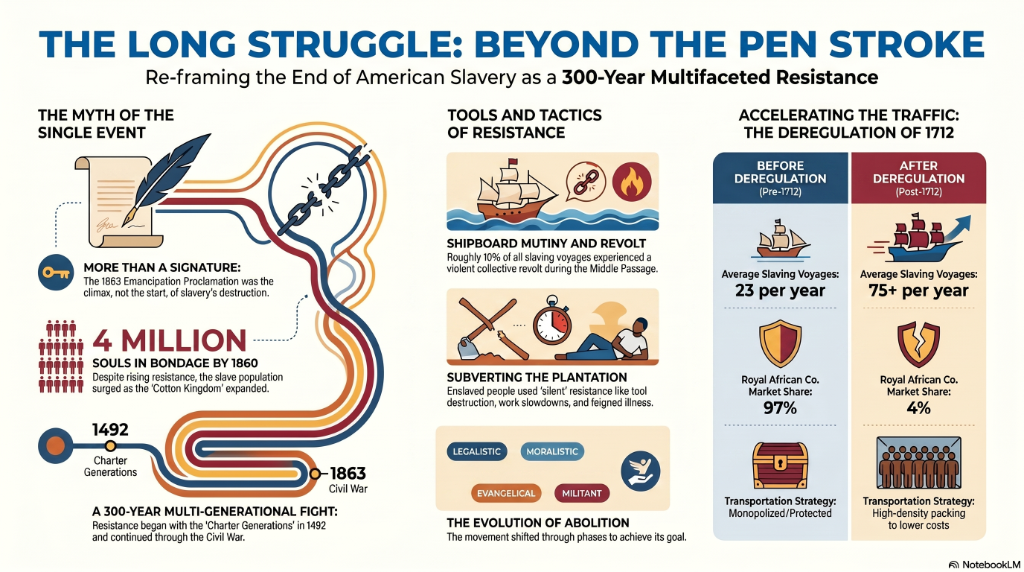 Source: NotebookLM — The Long Struggle Against Slavery infographic
The German Coast Uprising of 1811: The Largest Slave Revolt in U.S. History
January 8–10, 1811 — Along the German Coast of the Mississippi River in present-day Louisiana, 400–500 enslaved people rose up in the largest slave revolt in U.S. history. Led by Charles Deslondes, a free man of color from Haiti, the rebels marched toward New Orleans carrying cane knives, axes, and a few firearms.
The Haitian Revolution (cited above) was the direct inspiration: Deslondes had witnessed it firsthand, and many rebels were Haitian-born. The uprising was suppressed by U.S. militia and federal troops, and the leaders were executed — but its scale terrified the planter class across the South and triggered new, more brutal slave codes in Louisiana.
The Whitney Plantation in Wallace, Louisiana — the only plantation museum in the U.S. focused entirely on the lives of enslaved people — now memorializes this uprising with a dedicated monument.


