
African American History · Unit 2
The Transatlantic Rupture & Legalized Slavery
The Maafa — the economics of dehumanization and resistance
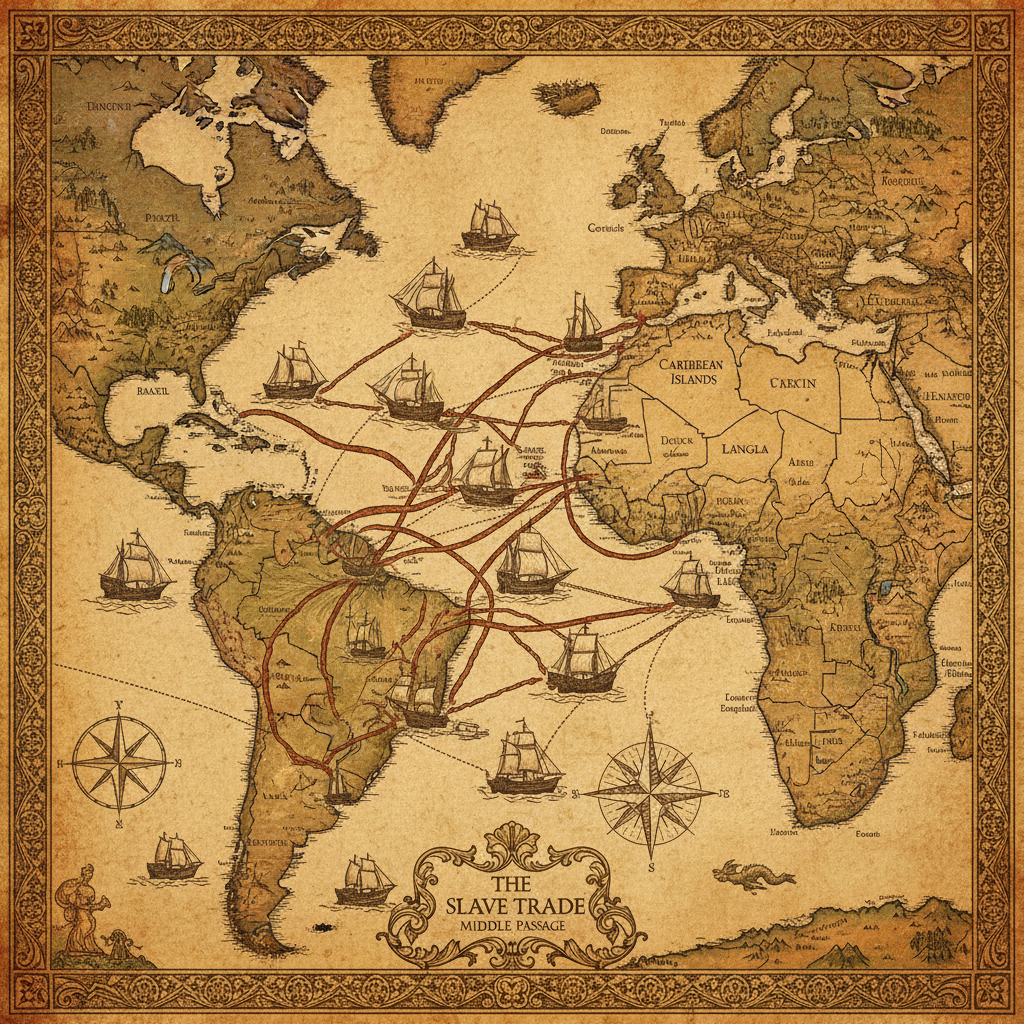
The transatlantic slave trade was not a tragedy that happened to passive victims. It was a precisely engineered economic system — built by European empires, financed by banks, insured by underwriters, and codified in law — that transformed human beings into fungible commodities and generated the capital that funded the Industrial Revolution. Captured Africans were sorted by age, health, and ethnic origin on the West African coast; packed into ships at ratios calculated to maximize profit against expected mortality; seasoned in Caribbean holding colonies before mainland sale; and entered into plantation ledgers as depreciating assets alongside livestock and tools. The Maafa — the Swahili word for this catastrophe, meaning "great disaster" — was not incidental to the rise of the Western world. It was foundational to it. And it was resisted at every stage: on the coast before boarding, on the ships through mutiny and self-destruction, on the plantations through sabotage and flight, and in the courts and legislatures through the testimony of those who survived. Throughout American history, African Americans repeatedly demonstrated loyalty, courage, civic commitment, and military service while being denied many of the rights associated with full citizenship including during the Revolutionary War.
Learning Objectives
- •Define the Maafa and explain why scholars prefer it over 'slave trade'
- •Analyze the economic logic of the slave ship and Middle Passage mortality
- •Trace how European legal codes attempted to strip captives of humanity
- •Document immediate and sustained resistance: rebellions, marronage, and Arabic-writing scholars
- •Examine the contradictions between American democratic ideals and racial inequality.
Unit 2 Knowledge Check
Score 70% or higher to complete this unit. Answers stay hidden until you submit.
1. J. Marion Sims performed approximately 30 surgical procedures on an enslaved woman named Anarcha without anesthesia, justifying this by arguing that Black people felt less pain than white people. A 2016 study found that half of medical students and residents still endorsed false beliefs about biological racial differences. What does this continuity reveal?
2. Henrietta Lacks's cells were taken without her knowledge or consent in 1951, used in over 70,000 scientific studies and at least 11,000 patents, and generated billions in commercial value — yet her family received nothing. A federal judge dismissed their lawsuit in 2023. How does the HeLa case connect to the history of enslaved bodies used for medical knowledge in Unit 2?
3. Which of the following best describes how African Americans used military service as a strategy for claiming citizenship rights?
4. What was Crispus Attucks's historical significance in the context of African American citizenship?
5. Brazil received approximately 4.9 million enslaved Africans — nearly ten times as many as the United States. What does this mean for understanding the African diaspora?
6. Quilombo dos Palmares (Brazil, c. 1600–1694) is significant because it:
7. Omar Ibn Said (c. 1770–1864) wrote an autobiography in Arabic while enslaved in North Carolina. This fact is most significant because it:
8. The Haitian Revolution (1791–1804) was uniquely threatening to slaveholding powers because:
9. The SlaveVoyages database documents approximately how many captives transported in the transatlantic trade?
10. Omar Ibn Said was remarkable as an enslaved person because he...
11. The South Carolina Negro Act of 1740 banned drums and musical instruments. What triggered this law?