
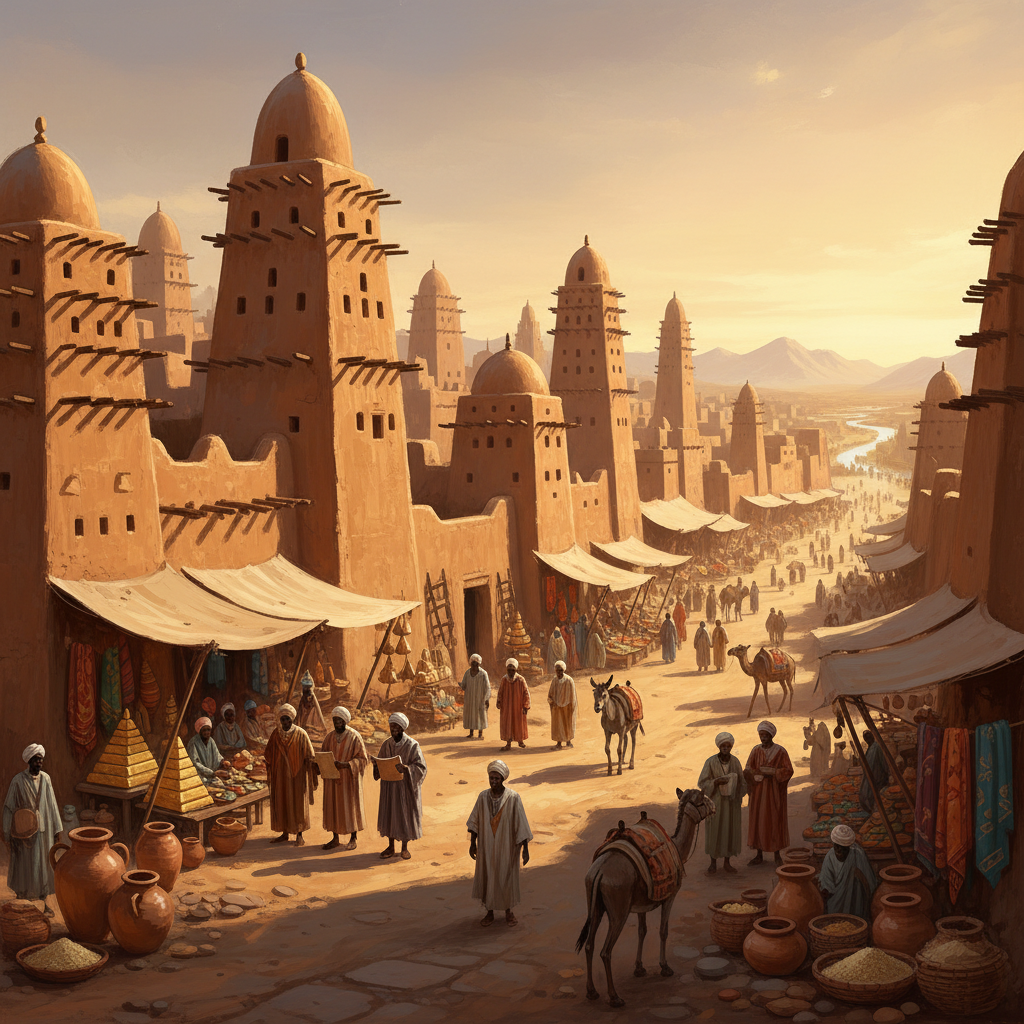
African American History · Unit 1
Pre-Colonial Sovereignty & Foundations
Empires, constitutions, and universities before the rupture
The great empires of West Africa, the architecture of Lalibela, Zimbabwe's stone cities, and the world's oldest university.
Learning Objectives
- •Describe the political structures and geographic scale of the Ghana, Mali, and Songhai empires
- •Explain the Kouroukan Fouga as an early constitutional document predating Magna Carta
- •Locate Lalibela and Great Zimbabwe as evidence of advanced pre-colonial African architecture
- •Identify the University of Al-Qarawiyyeen (founded 859 CE) as among the oldest continuously operating institutions of higher learning in the world
Unit 1 Knowledge Check
Score 70% or higher to complete this unit. Answers stay hidden until you submit.
1. Queen Mothers in Akan societies held which formal political function?
2. W.E.B. Du Bois's concept of "double consciousness" describes which of the following?
3. The griot tradition in West Africa is best understood as:
4. The Kouroukan Fouga (Mali Empire, c. 1235 CE) is historically significant because it:
5. Timbuktu under the Songhai Empire held approximately 25,000 university students. What does this most directly challenge?
6. Great Zimbabwe's stone enclosures (c. 1100–1450 CE) challenge which common assumption about pre-colonial Africa?
7. The Kouroukan Fouga was proclaimed in approximately 1235 CE. How does this compare to the Magna Carta?
8. Mansa Musa's 1324 pilgrimage to Mecca caused what economic effect in the Mediterranean?
9. The University of Al-Qarawiyyeen was founded in 859 CE by Fatima al-Fihri. What does this make it?
10. The churches of Lalibela (c. 1200 CE) are remarkable for what architectural reason?
Agency and Governance in Pre-Colonial Africa
Document-Based Task · scored with the essay rubric
Using the provided documents, analyze how pre-colonial African societies established systems of governance and social order. In your response, evaluate the extent to which these political structures relied on oral tradition, legal codification, or religious authority to maintain stability and legitimacy across diverse regions.
Source Documents
The Kouroukan Fouga (The Manden Charter)
Primary SourceThe Travels of Ibn Battuta (Description of the Mali Empire)
Primary SourceThe African Diaspora: A History through Culture (Chapter on African Statecraft)
Secondary Source