
African Political Thought · Unit 1
Oracles, Scripts, and Sages
Three African philosophical traditions that operated on their own terms, long before any European encounter
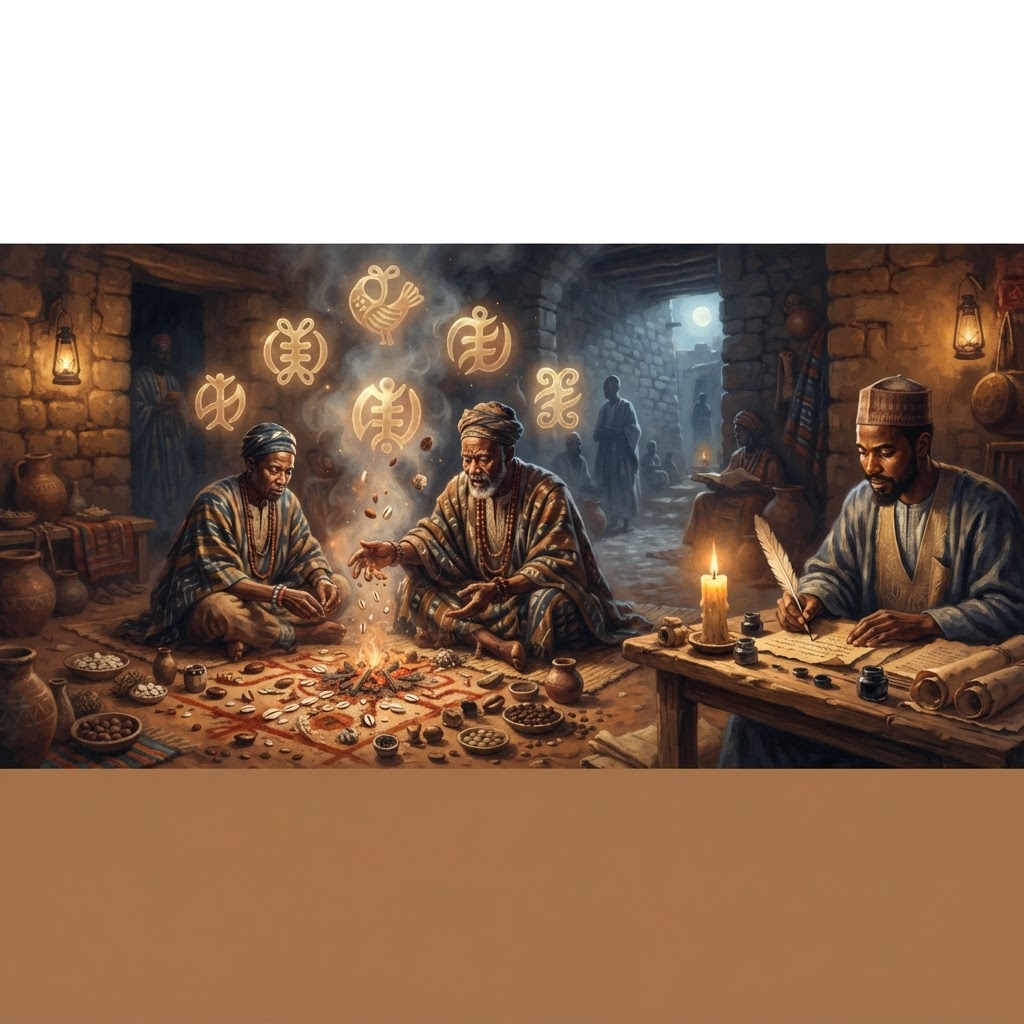
This unit opens the course with three distinct African intellectual traditions, each a genuine philosophical system in its own right: the Ifa divination corpus of the Yoruba, an oral encyclopedia of ethics, cosmology, and epistemology encoded in 256 verses; Zera Yacob's seventeenth-century Ethiopian treatise of rationalist inquiry, developed independently of and roughly contemporaneous with Descartes; and the Islamic scholarly tradition of Timbuktu, whose libraries held hundreds of thousands of manuscripts on law, astronomy, and philosophy centuries before European colonization began.
Learning Objectives
- •Students will be able to describe the Ifa divination system's structure and explain why scholars including Sophie Oluwole argue it constitutes a genuine epistemological and ethical system rather than mere superstition.
- •Students will analyze Zera Yacob's Hatata as an independently developed rationalist philosophy, and evaluate why comparisons to Descartes both illuminate and risk obscuring its distinct Ethiopian context.
- •Students will explain the scale and scope of Timbuktu's manuscript tradition and evaluate how it challenges historical narratives that treat sub-Saharan Africa as lacking sophisticated scholarly institutions before European contact.
- •Students will compare all three traditions examined in this unit as evidence of independently developed African systems of reasoning, ethics, and knowledge production, existing in genuine conversation with, but never dependent on, outside philosophical traditions.
Unit 1 Knowledge Check
Score 70% or higher to complete this unit. Answers stay hidden until you submit.
1. What specific event in 2013 threatened Timbuktu's manuscript tradition, and how did local and international efforts respond?
2. What distinguishes Zera Yacob's philosophical skepticism from Descartes's, according to some scholarly comparisons?
3. Why does the philosopher Sophie Oluwole argue that the Ifa divination corpus constitutes genuine philosophy rather than mere superstition?
Intellectual Independence and Knowledge Systems
Document-Based Task · scored with the essay rubric
Using the provided documents, analyze how African intellectual traditions in the Yoruba, Ethiopian, and Malian contexts asserted independent frameworks of truth, logic, or ethics. How do these sources reflect the diversity of ways African scholars organized, preserved, and defended knowledge systems against both internal and external pressures? In your response, synthesize the ways each tradition utilizes specific methods—oral, written, or solitary contemplation—to establish authority.
Source Documents
The Odu Ifa (Yoruba Oral Corpus)
Primary SourceHatata (The Treatise of Zera Yacob)
Primary SourceThe Timbuktu Manuscripts: The History of the Mali and Songhai Empires
Primary Source