
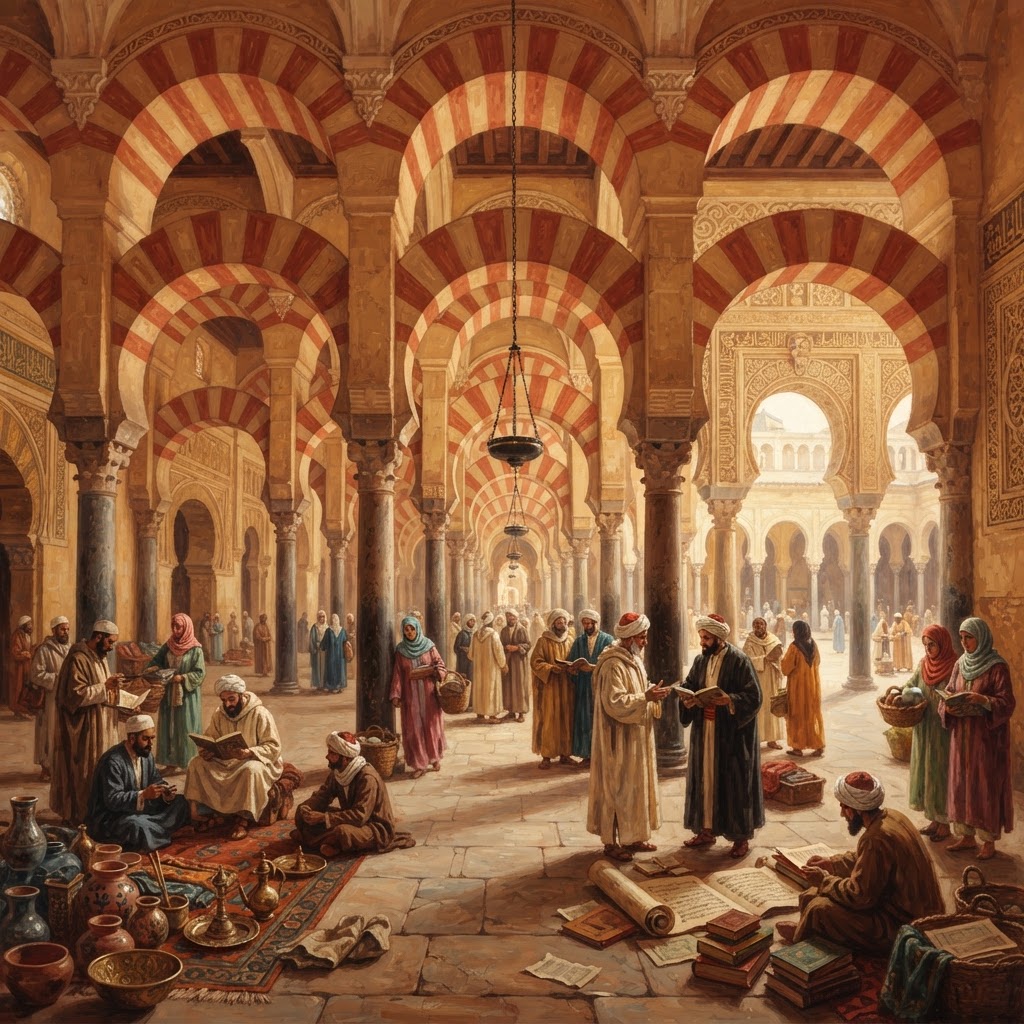
African Diaspora in Europe · Unit 1
Al-Andalus and Moorish Iberia
Seven centuries of African and North African presence in Europe, seven centuries before the transatlantic slave trade began
This unit opens a new course by going back further than any of this project's other curricula: to 711 CE, when Berber and Arab forces crossed from North Africa into the Iberian Peninsula and began nearly 800 years of Muslim rule. It examines who actually made up the population Europeans called 'Moors,' the genuine but often overstated presence of sub-Saharan Africans within that population, and the 1492 collapse of Granada that ended Al-Andalus and set in motion the expulsion of hundreds of thousands of Muslims and Jews from Iberia.
Learning Objectives
- •Students will be able to describe the 711 Umayyad conquest of Iberia and explain the demographic composition, predominantly Arab and Berber, of the society that became Al-Andalus.
- •Students will analyze the historical debate over the term 'Moor,' distinguishing its primary reference to Arab and Berber North Africans from the genuine but numerically smaller presence of sub-Saharan Africans, called 'tangerines,' within Al-Andalus.
- •Students will evaluate Ziryab as a case study in historical uncertainty, assessing why his ethnic origin remains genuinely disputed among scholars rather than settled.
- •Students will explain the 1492 fall of Granada and trace the subsequent expulsion and forced conversion of Iberia's Muslim and Jewish populations through the early seventeenth century.
Unit 1 Knowledge Check
Score 70% or higher to complete this unit. Answers stay hidden until you submit.
1. What happened to Spain's Morisco population between 1492 and 1614?
2. Why does this unit present Ziryab's ethnic origin as a genuinely unresolved historical question rather than settling it definitively?
3. According to this unit, what does the 1911 Encyclopaedia Britannica's observation that 'the term Moors has no real ethnological value' reveal about the word's historical usage?
4. What was the actual ethnic composition of the force that conquered Iberia in 711 and the broader population of Al-Andalus that followed?
Constructing Identity: The Legacy of Moorish Iberia
Document-Based Task · scored with the essay rubric
Using the provided documents, analyze how the identity of the 'Moor' was constructed and contested during the period of Al-Andalus. To what extent do these sources suggest that Iberian identity was defined by religious affiliation, geographic origin, or cultural synthesis? Formulate an argument that evaluates how the shifting status of North African populations reflects the broader evolution of European history from 711 to 1492.
Source Documents
The Chronicle of 754 (Mozarabic Chronicle)
Primary SourceThe Ornament of the World: How Muslims, Jews, and Christians Created a Culture of Tolerance in Medieval Spain by Maria Rosa Menocal
Secondary SourceThe Nasrid Kingdom of Granada: A Brief History by Leonard P. Harvey
Secondary Source