
African American History · Unit 7.5
Immigration & Connection
The Diaspora in Motion
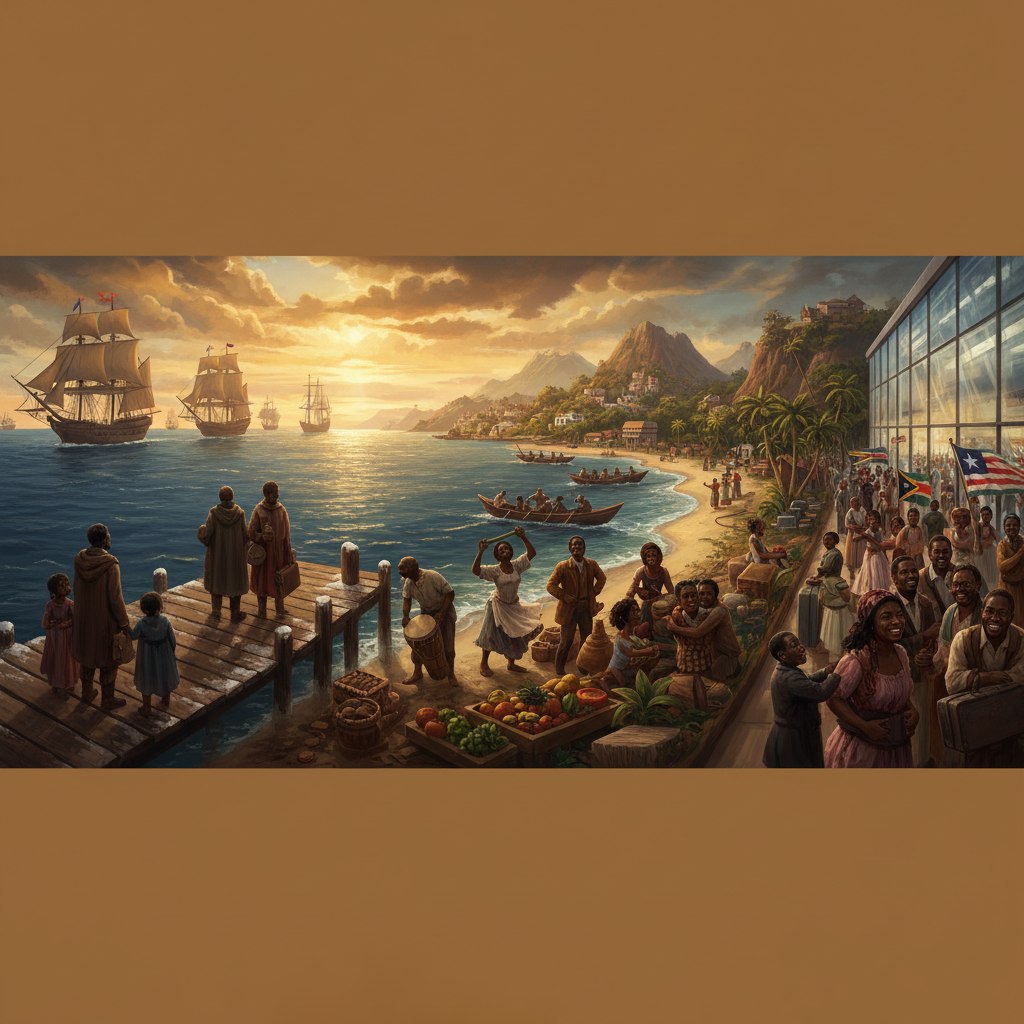
The slave trade did not deposit people in one place and leave them. Captured Africans were seasoned in the Caribbean before mainland sale, punished by relocation across the Atlantic, and sold by the very British allies they had fought beside. African Americans fled north to Canada. Black Loyalists sailed to Sierra Leone. Free Black Americans built Liberia. Modern immigration from the Caribbean and Africa continues the same Atlantic circulation. W.E.B. Du Bois's father was Haitian. Any of us could have descended from people who lived across multiple continents and islands. The diaspora was never settled — it was always in motion, always resisting, always reconnecting.
Learning Objectives
- •Explain how the slave trade functioned as a system of continuous displacement rather than a single crossing, and identify at least three directions of movement beyond the standard Africa-to-mainland narrative
- •Trace the specific movements of Black Loyalists from the American Revolution through Nova Scotia to Sierra Leone as an example of a single community crossing three continents
- •Analyze Haiti's role as both the only successful slave revolution and a continuous source of diaspora connection — from Du Bois's father to the modern TPS crisis — as evidence that Caribbean and African American history are inseparable
- •Evaluate how modern immigration from the Caribbean and Africa both continues historical patterns of Atlantic circulation and creates new tensions and connections within the contemporary diaspora
Unit 7.5 Knowledge Check
Score 70% or higher to complete this unit. Answers stay hidden until you submit.
1. The transatlantic slave trade deposited approximately 388,000 captives in what is now the United States — roughly 3.6% of the total. Where did the majority of enslaved Africans go?
2. The 'seasoning' of enslaved Africans in the Caribbean before sale to mainland colonies had what unintended cultural consequence?
3. Approximately 3,500 Black Loyalists were transported to Nova Scotia after the American Revolution, having been promised freedom for supporting the British. What happened to them in Canada, and what happened next?
4. W.E.B. Du Bois wrote 'We know nothing of Africa' — yet his father Alfred was Haitian-born. What does this biographical fact reveal about the unit's central argument?
5. France forced Haiti to pay 150 million francs in 'reparations' to former slaveholders as the price of diplomatic recognition after the 1804 revolution. Haiti finished paying this debt in 1947. What does this fact most directly explain?
6. The Liberia founding involved both abolitionists and slaveholders supporting the American Colonization Society. Frederick Douglass opposed it vigorously. What was his argument, and what did those who went argue in response?
7. The 1965 Immigration and Nationality Act abolished racial quotas that had effectively barred immigration from most of Africa and the Caribbean. What was the primary unintended consequence for the African diaspora in America?
8. The Windrush generation came to Britain as citizens of the British Empire, worked and paid taxes for decades, and were then wrongly detained and deported beginning in 2018. Haitian migrants who built lives in the United States under humanitarian parole and Temporary Protected Status (TPS) faced the loss of those protections and deportation after a 2025 Supreme Court ruling allowed the federal government to end the programs. What structural similarity connects these cases?
9. DNA ancestry testing has found that significant portions of African Americans show genetic signals consistent with Caribbean intermediate ancestry. What does this finding confirm about the history covered in this unit?
10. Ghana declared 2019 the Year of Return, inviting diaspora Africans to visit and offering citizenship. Some African Americans chose to stay permanently. What does this movement represent in the context of the unit's argument?