
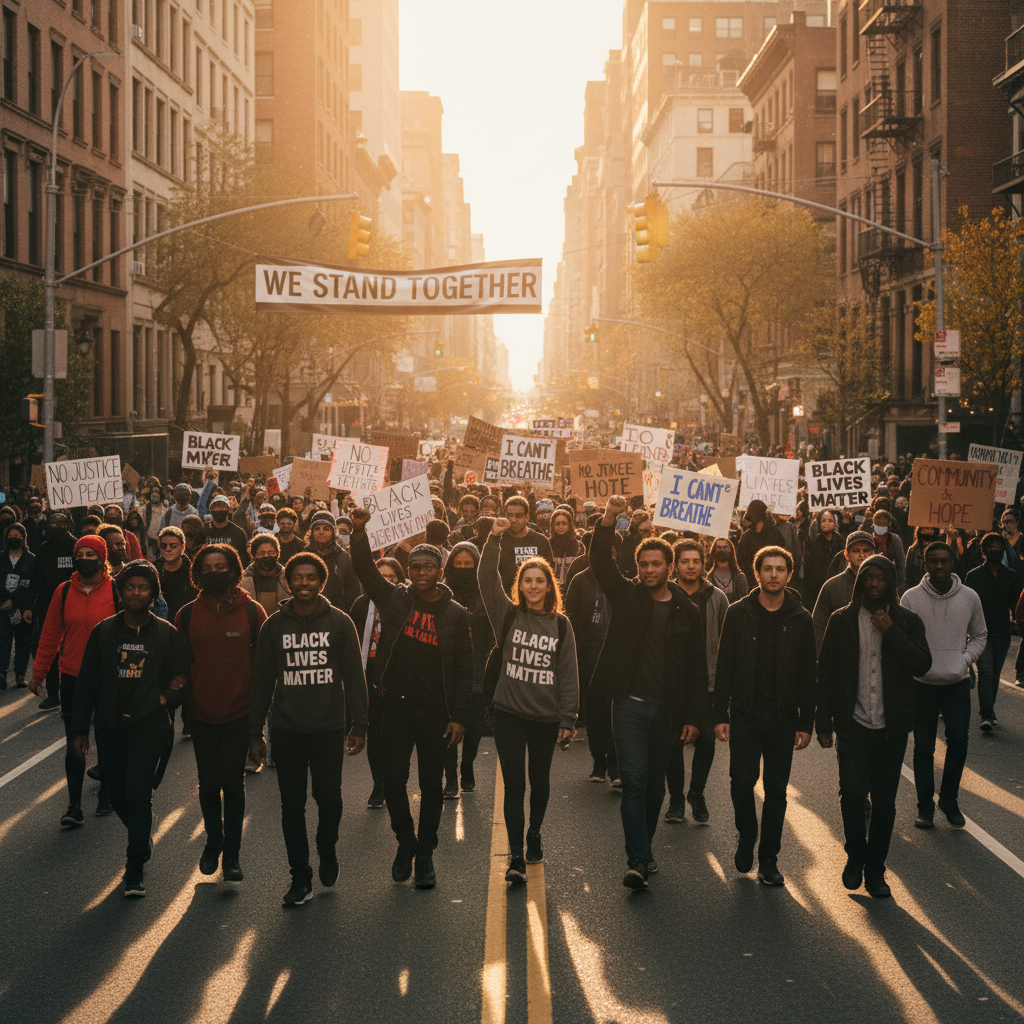
African American History · Unit 7
The Ongoing Freedom Struggle & Global Diaspora
From Civil Rights to Black Lives Matter — A Living Movement
This unit traces the unfinished arc of Black liberation from the post-Civil Rights era to the present day, examining how African Americans and the global diaspora continue to fight for justice, representation, and self-determination. We explore social movements, cultural production, political organizing, and the digital age's impact on Black consciousness across continents.
Learning Objectives
- •Analyze the continuities between historical freedom struggles and contemporary movements like Black Lives Matter
- •Evaluate the role of digital media and social networks in organizing global Black resistance
- •Examine how African nations and diaspora communities are forging new solidarity frameworks in the 21st century
- •Critically assess the intersections of race, class, gender, and nationality in ongoing liberation movements
- •Connect present-day struggles to the Sankofa principle — drawing from the past to build the future
Unit 7 Knowledge Check
Score 70% or higher to complete this unit. Answers stay hidden until you submit.
1. Arline Geronimus's 'weathering' concept explains that Black women's health deteriorates faster and earlier than white women's, measured in telomere length, cortisol levels, and inflammatory markers. What does weathering identify as the primary cause of this biological aging acceleration?
2. Black Americans died from COVID-19 at 1.9 times the rate of white Americans in the pandemic's first year. Public health officials cited higher rates of pre-existing conditions including hypertension and diabetes. What does this curriculum's health and medicine thread add to that explanation?
3. Research consistently documents that Black patients are undertreated for pain relative to white patients with identical conditions. A 2016 study found 50% of medical students and residents endorsed false beliefs about Black patients' pain sensitivity. How does this connect to the history of J. Marion Sims operating on Anarcha without anesthesia in 1845?
4. Michelle Alexander argues in 'The New Jim Crow' that mass incarceration constitutes a racial caste system. What is the strongest piece of evidence for this claim beyond incarceration statistics?
5. Ruth Wilson Gilmore argues that prisons are built where land is cheap and state investment has been withdrawn, not primarily where crime is highest. What does this geographic analysis reveal about the function of mass incarceration?
6. The Haitian Revolution (1791–1804) was uniquely significant in world history because:
7. The Tulsa Race Massacre of 1921 is historically significant as a case study in Black economic destruction because:
8. Which principle, rooted in Akan philosophy, best describes the idea of learning from the past to build a better future — a theme central to contemporary Black liberation movements?
9. The Black Lives Matter movement was founded in 2013 in response to which event?
10. How did digital media and social networks fundamentally change Black resistance organizing in the 21st century?
11. Which term describes the Akan philosophical concept that 'it is not taboo to go back and retrieve what you forgot'?
12. In what way are 21st-century diaspora solidarity frameworks between African nations and African Americans considered 'new'?
13. Alice Walker coined 'Womanism' as distinct from mainstream feminism primarily because:
14. Ella Baker's philosophy 'Strong people don't need strong leaders' was a direct critique of:
Structural Exclusion and the Battle for Agency
Document-Based Task · scored with the essay rubric
Analyze how the intersection of political disenfranchisement and systemic state violence has shaped Black efforts to secure bodily autonomy and legislative power. In your response, synthesize the provided documents to evaluate whether institutional representation alone can address the challenges of the carceral state and health inequity, or if these disparities require fundamentally different strategies for reform.
Source Documents
Abolition Democracy: Beyond Prison, Torture, and Empire (Angela Davis)
Secondary SourceBlack Codes and the Post-Civil War Carceral System (Historical Archive Records)
Primary SourceThe 1910 Census and the Under-representation of Black Populations in Public Health Data
Primary Source