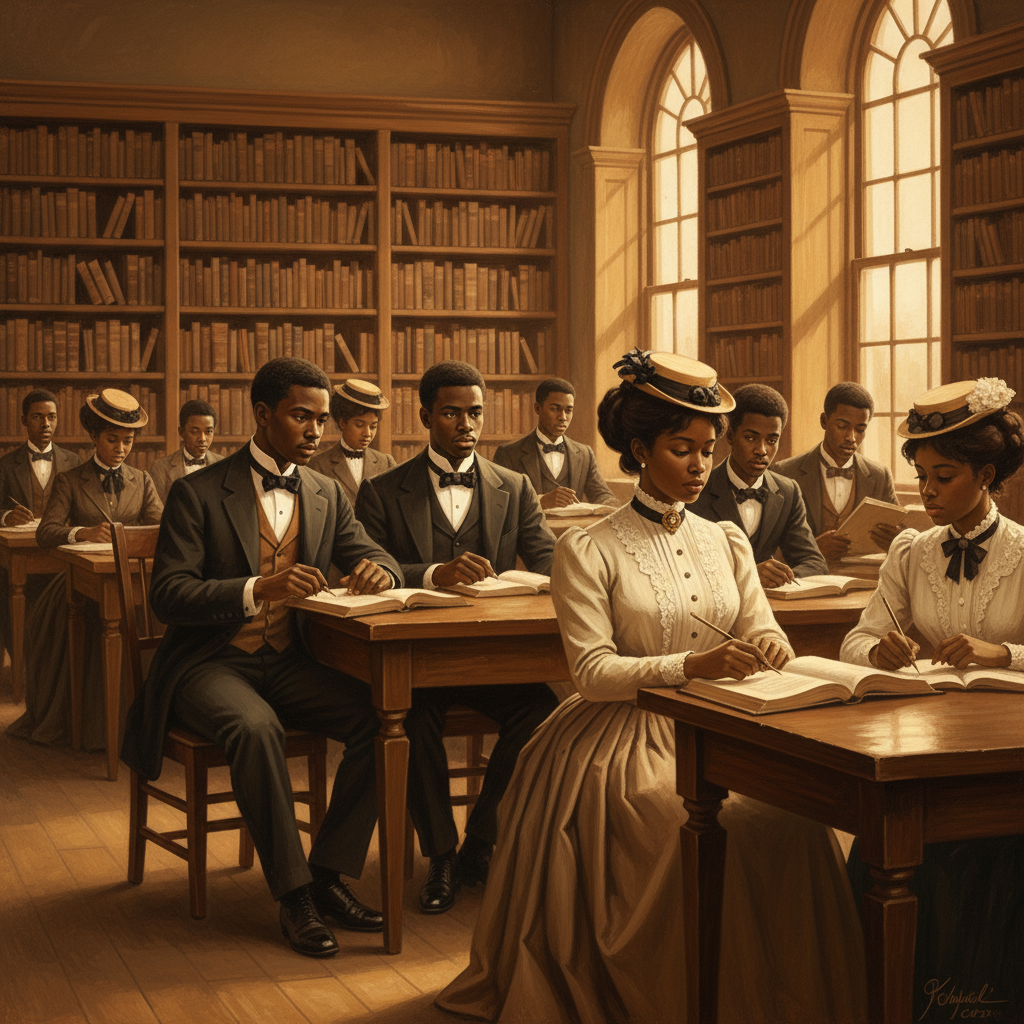
From Reconstruction's collapse to African independence via Lincoln University
Jim Crow, the founding of HBCUs, and the African leaders who studied there before liberating their nations.
Learning Objectives
•Explain the collapse of Reconstruction and the legal architecture of Jim Crow
•Describe how Black churches founded HBCUs as parallel educational institutions
•Profile Azikiwe, Nkrumah, Ako-Adjei, and Blyden as HBCU-to-independence pipeline figures
•Analyze how Lincoln University became a cradle of Pan-African anti-colonial thought
Unit 4.5 Knowledge Check
Score 70% or higher to complete this unit. Answers stay hidden until you submit.
1. Debt peonage was made a federal crime by the Peonage Act of 1867 — yet the system persisted in the South until World War II. What does this gap between law and practice reveal?
2. After Bailey v. Alabama (1911) struck down debt peonage contracts, the peonage system adapted rather than ended. What does this adaptation reveal about the relationship between legal reform and structural change?
3. In Louisiana, Black voter registration fell from 130,334 in 1896 to 1,342 in 1904 — a reduction of 99%. This collapse occurred through legal mechanisms, not mass violence. What does this demonstrate about the relationship between law and racial control?
4. The white primary — allowing the Democratic Party to exclude Black members on the grounds that it was a private organization — was struck down by the Supreme Court in Smith v. Allwright (1944). Why was eliminating the white primary insufficient to restore meaningful Black political participation in the South?
5. The 13th Amendment (1865) abolished slavery 'except as a punishment for crime.' How was this exception weaponized during the convict leasing era?
6. The Black Feminist Political Thought tradition represented by Wells, Hamer, and Baker shared which core theoretical commitment?
7. Kimberlé Crenshaw's theory of 'intersectionality' (1989) argued that:
8. Ida B. Wells's investigative journalism on lynching (1892–1900) was groundbreaking because it:
9. Fannie Lou Hamer's challenge to the 1964 Democratic National Convention was historically significant because:
10. What term did historian Albert Raboteau use to describe the secret, unauthorized religious gatherings enslaved Africans held away from white surveillance in swamps and forests?
11. Marcus Garvey's Black Star Line was described as threatening enough to prompt the FBI's J. Edgar Hoover to personally direct a case against him. Why was the Black Star Line so politically significant?
12. W.E.B. Du Bois described 'Reconstruction' as 'America's Unfinished Revolution.' What ended Reconstruction in 1877?
13. What was Lincoln University's unique significance in the context of African independence movements?
14. Which Supreme Court ruling in 1896 provided the legal foundation for Jim Crow segregation across the United States?
15. What were the Tuskegee Airmen, and why are they historically significant?
Architectures of Control and Black Agency
Document-Based Task · scored with the essay rubric
Analyze how Black activists and thinkers developed intellectual and institutional strategies to counter the systemic state-sanctioned violence and disenfranchisement following the 13th Amendment. Using the provided documents, evaluate the ways in which these individuals moved beyond mere protest to construct political theories and community infrastructures that challenged the legal architecture of post-Reconstruction America.
Source Documents
Ida B. Wells, Southern Horrors: Lynch Law in All Its Phases (1892)
Primary Source
The 13th Amendment to the U.S. Constitution (1865)
Primary Source
W.E.B. Du Bois, The Philadelphia Negro: A Social Study (1899)