
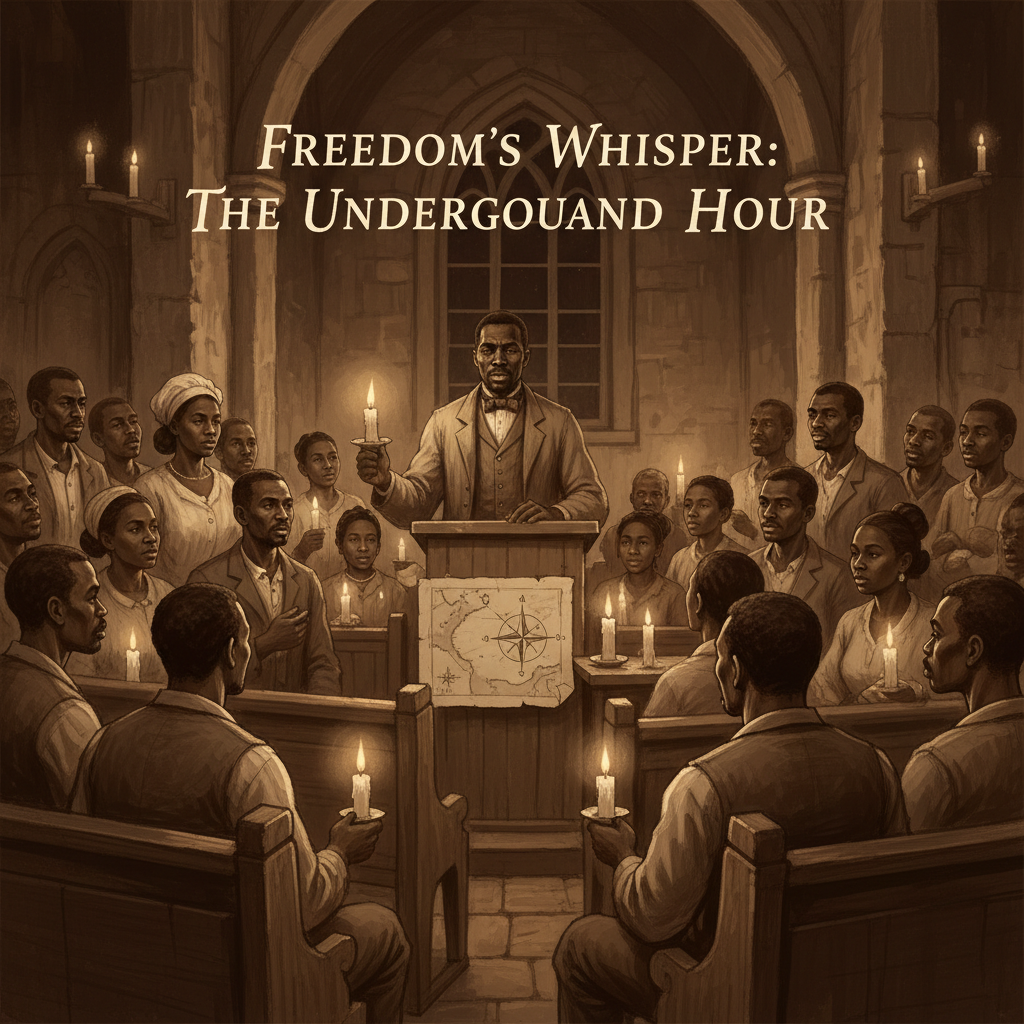
African American History · Unit 4
Agency, Resistance, and the Architecture of Freedom
1820–1865 · From Convention to General Strike
Students move beyond the reactive history of the early Republic to analyze the proactive, organized, and intellectual resistance movements that forced the collapse of the slave system and established the infrastructure for post-emancipation life.
Learning Objectives
- •Analyze how enslaved and free Black people constructed clandestine and public networks to challenge the legal and economic status quo.
- •Evaluate the role of Black-led institutions — churches, mutual aid societies, and conventions — in establishing the blueprint for the HBCU movement.
- •Apply the 'resistance within constraint' framework: understand agency as calculated, high-stakes, and rational rather than simply heroic.
- •Trace the evolution from local protest to organized national political mobilization through the Black Convention Movement and the Black Press.
- •Synthesize the transition from grassroots resistance to the political 'General Strike' that made Emancipation inevitable — centering it as Black achievement, not state gift.
Unit 4 Knowledge Check
Score 70% or higher to complete this unit. Answers stay hidden until you submit.
1. 22 Black men served in Congress during Reconstruction. W.E.B. Du Bois described Reconstruction governments as among 'the most democratic and progressive in American history.' What was the most significant legislative achievement of this period that has been largely erased from mainstream historical memory?
2. The Compromise of 1877 resolved the disputed presidential election by giving Rutherford Hayes the presidency in exchange for withdrawing federal troops from the South. What was the immediate consequence for Black political participation?
3. Booker T. Washington's 1895 'Atlanta Compromise' speech proposed that Black Americans should prioritize:
4. W.E.B. Du Bois's concept of the 'Talented Tenth' argued that Black liberation required:
5. The preferred historical term for enslaved people who escaped bondage through their own planning and action is:
6. Which institution provided the direct institutional lineage from the mutual aid society movement to the first HBCU?
7. W.E.B. Du Bois introduced the concept of the 'General Strike' to describe which historical event?
8. The Fugitive Slave Act of 1850 differed from the 1793 Act most significantly because it:
9. The First National Negro Convention (1830) was convened in direct response to which event?
10. During the Civil War, the 54th Massachusetts Infantry Regiment became a symbol of what contradiction in American democracy?
11. Marcus Garvey's Black Star Line (1919) was designed to achieve which goal?
12. The Red Summer of 1919 refers to:
13. Lincoln University's connection to African independence is best described by which example?
14. The collapse of Reconstruction in 1877 was primarily caused by:
Agency and Strategy in the Struggle for Freedom
Document-Based Task · scored with the essay rubric
Analyze how these documents illustrate the shift from grassroots institution-building to national political agitation in the pursuit of Black liberation. To what extent do these sources support the argument that African American freedom was a result of self-directed agency rather than government policy? Synthesize your findings to argue whether internal community organization or external political pressure was the more effective catalyst for Black empowerment between 1840 and 1905.
Source Documents
Report of the Proceedings of the Colored National Convention, 1853
Primary SourceW.E.B. Du Bois, The Souls of Black Folk (Chapter III: Of Mr. Booker T. Washington and Others)
Primary SourceW.E.B. Du Bois, Black Reconstruction in America: An Essay Toward a History of the Part Which Black Folk Played in the Attempt to Reconstruct Democracy in America, 1860-1880
Secondary Source