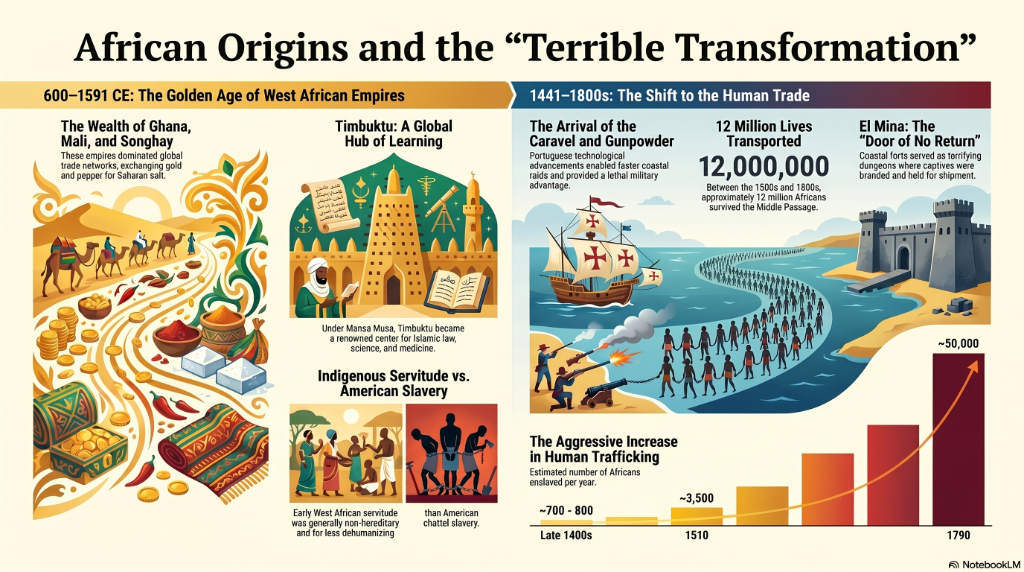
Three Empires, One Continuous Civilization
Eurocentric textbooks present sub-Saharan Africa before European contact as stateless and pre-civilizational. The archaeological and documentary record disagrees — dramatically.
The Ghana Empire (c. 300–1200 CE)
Located in modern-day southern Mauritania and Mali (not present-day Ghana), the Ghana Empire controlled the trans-Saharan gold-salt trade. Arab travelers like Al-Bakri (1068 CE) described Ghana's capital Kumbi Saleh as a twin city of 30,000 people, with a palace district, a mosque, and a justice system. The king held court in elaborate ceremonial dress with gold ornaments, surrounded by an army of 200,000 warriors.
The Mali Empire (c. 1235–1600 CE)
Mansa Musa's 1324–25 hajj pilgrimage to Mecca is one of the most documented events in medieval world history. He traveled with 60,000 people, 12,000 enslaved servants, and 80 camels carrying 300 pounds of gold each. His spending in Cairo and Egypt so flooded the Mediterranean gold market that gold's value did not recover for a decade. He founded the Sankore mosque-university in Timbuktu.
The Songhai Empire (c. 1464–1591 CE)
Under Sunni Ali and Askia Muhammad, Songhai became West Africa's largest empire, stretching from the Atlantic coast to modern Nigeria. Timbuktu under Askia Muhammad held 25,000 university students at its peak — comparable to Oxford in the same era.
The continental parallel for today's students: these were not anomalies. They were the baseline.